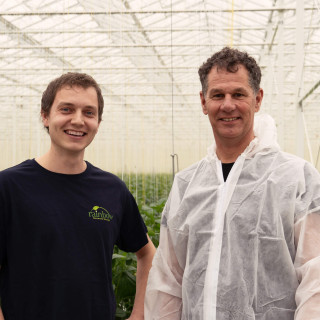
How Paweł Kida Turned a High-Risk Cultivation Bet into Mularski's Best Season on Record
Mularski is one of Poland's largest greenhouse producers, operating over 45 hectares across multiple sites in northern and southern Poland. The company grows tomatoes and cucumbers year-round, using advanced lighting and climate technology throughout their facilities.

The Challenges
Last season, Head Grower Paweł Kida identified an opportunity to push further: stop shading the roof, raise 24-hour temperature setpoints, and increase leaf density from 15 to 20 leaves per stem. His theory: more leaves at higher heat drives faster truss development, with simpler trusses that are easier to manage.
Internal resistance to strategy changes.
The rest of the team saw risk. Colleague growers, the labour manager, and IPM colleagues raised concerns, and without hard evidence at this scale, the strategy was difficult to defend. "I wanted to prove the others wrong, those who thought I had messed up by pruning differently," Paweł says.
Limited yield, whilst labor costs and waste were high.
The existing approach had real costs: complex truss structures meant high pruning effort and consistent crop waste averaging 5% of total fruit.
How Source Cultivation Management Helped
Paweł used Source Cultivation Management to run this experiment across 12 hectares with a clear view of the state of the crop. Source Cultivation Management lets growers define a cultivation plan (like expected flowering speed, fruit set, and fruit weight development) and automatically compare real plant observations against it every day.
Catching deviations before they compound.
If fruit weight was drifting or fruit set falling behind plan, the KPI indicators in Source flagged it early. If they stayed on track, Paweł knew he could keep pushing. "With the data, I don't have to guess. I can see it's working."
Showing the numbers.
Every Tuesday, Paweł brought the Source data to the team meeting. Fruit set had risen from 60 to 80 fruits per week. The numbers settled the argument.
Results

Scaling the Win Across Sites
Beyond the results themselves, Mularski left the season with a blueprint.
Because the full strategy was documented and tracked in Source throughout the season, it could be transferred. Mularski applied the same crop plan to their other sites, including one 400 km away. The growers there had access to the same plan, the same benchmarks, and the same early-warning logic.
For a business managing multiple locations, strong cultivation decisions become repeatable across sites and teams.
The Takeaway
Paweł Kida's experiment worked because deep cultivation knowledge and real-time verification reinforced each other. Source gave him the evidence to act on his expertise at scale, and to bring the rest of the team along with him.
“For the first time ever, I'm trying these strategies at this scale. With the data, I don't have to guess.”

Paweł Kida
Head Grower, Grupa Mularski

Interested in how Source Cultivation Management works?

More cases
Agrocare Rilland
A Consistent View of Cultivations Using Source Workspace, and a Time-Saving of 45%
Agro Care
"The Source Workspace dashboard is a huge mirror held up to you as a grower''
Bryte Greenbalance
Enabling Precise Greenhouse Oversight with Source Workspace